I often have the opportunity to investigate rich, deep, and varied narratives about the past in unfamiliar towns and communities. The distinctive heritage of these places, along with the complex forces that connect communities and families to their roots, is something I enjoy digging up during my research.
One unconventional technique I have honed over my decades of rummaging around new, untraveled territory while researching the past is to find a police officer right away. It isn’t because there is some trouble brewing mind you, and I’m not looking for your average 20-something beat officer. No, I need someone special, say an 80-year-old who worked the streets and back alleys day and night for at least a generation. When these old-style lawmen weren’t busy taking care of wayward types and carting drunks off to jail, they kept an eye on everything on their beat. This way I get a unique perspective, a cops eye view of the day in and day out goings-on from someone who knew their beat and town like no one else could. This often makes my work much more complete as I try to understand the essence of happenings long ago.
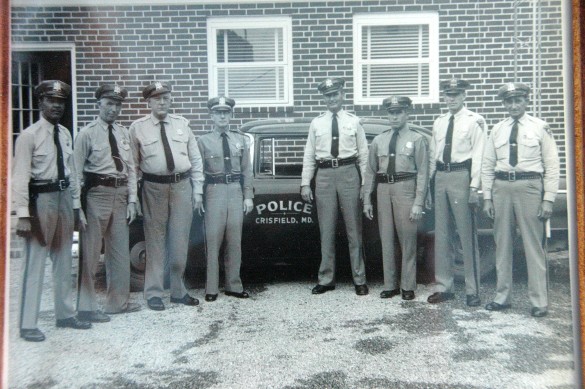
As an example, once when I was on the Lower Eastern Shore, my work took me to Crisfield, MD. I stopped by city hall to see if I could find some leads and the clerk put me in touch with 82-year-old Jesse Carmine. Still, on the payroll, he had worked for the city for over a half-century, most of it as a police officer.
They called the building inspector on the radio and it wasn’t too long before the public works truck pulled up. After explaining my purpose, we talked. He was born in 1921 in Crisfield and after serving in the U.S. Navy in World War II the young sailor returned home to start working as a patrolman in 1953. Serving on the force until 1991, he was promoted to chief in 1977. But after retiring from police work the city still needed his service, so he returned as acting chief for a period in 1997 and served as an inspector in public works for a number of years.
We climbed into the city pickup and retired Chief Carmine took me on a revealing, insightful tour of Crisfield, a place he knew so very well, having grown up there in the decade before World War II. He shared stories about the passage of the 20th century in the watermen’s town, and accounts of nearly 50 years of prowling the night, chasing speeders, corralling troublemakers and putting jailbirds behind bars. It was a time when policing was far different. He talked about an era when the officers walked a beat as they was no patrol car, special training wasn’t required, and the challenges the men faced were far different.
I thoroughly enjoyed that summer afternoon some years back and each time I returned to Somerset County I would ask about Chief Carmine. As the years passed by he finally retired from his job in public works. In the summer of 2008, I stopped by the Tawes Museum and the volunteer on duty mentioned that he passed away over the winter. As I pulled away from the museum, the memories of that meeting some years earlier were still very fresh in my mind.
I was fortunate to have met Mr. Jesse Carmine, and be able to learn about a different time and place in a changing Maryland community. His were rich stories and to some degree, they were accounts that were going to fade, as one generation gave way to another. Coming from a lawman who touched the past in Crisfield in many ways, the old stories and nearly forgotten memories, were narratives that deserved to be remembered.